تواصل معنا

From ZAKA Alumni to AI for Good Finalists: Team Nabra’s Journey

Nabra is an AI platform that analyzes children’s speech to provide clear, therapist-ready insights while creating a safe, playful experience. Developed by ZAKA graduates, it combines cutting-edge AI with compassionate design. Reaching the AI for Good Sandbox finals showed how human-centered AI can make a real impact and transform learning into meaningful innovation.

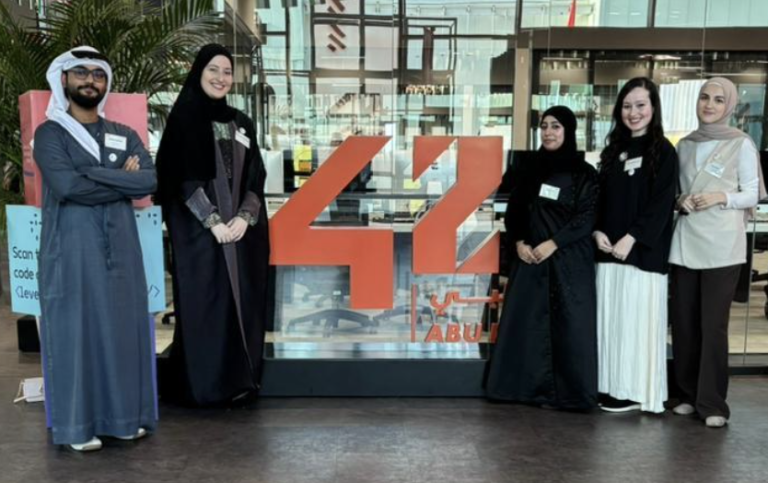
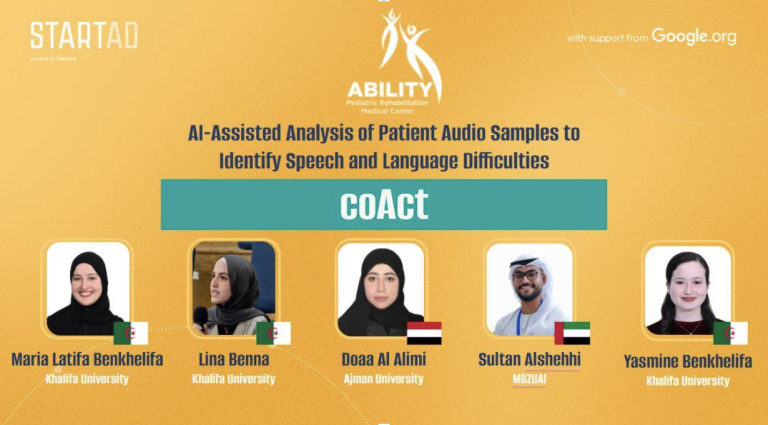
We are Team Nabra, Maria Latifa Benkhelifa, Lina Benna (ZAKA alumna), Yasmine Benkhelifa, Doaa Al Alimi, and Sultan Alshehhi. Our journey toward the AI for Good Sandbox began with the Nomu Al Ghurair: Women in AI Program by the Abdulla Al Ghurair Foundation and ZAKA, a transformative five-month experience that reshaped not only our technical abilities but also our purpose. Through this program, we completed the Machine Learning track, grounding us in ethical, responsible, and human-centered AI.

Maria’s capstone project, BookBuddy AI, an Arabic reading assistant, became the spark that inspired our team to pursue AI for social impact. Seeing technology empower young readers was the moment she discovered her identity as “The AI Healer.” It set the tone for our entire team: to build AI with empathy, intention, and impact.

In September 2025, the AI for Good Sandbox, organized by startAD and supported by global partners, launched a national innovation challenge focused on developing AI solutions that advance SDG 3: Good Health and Well-Being. The program brought together students, engineers, healthcare innovators, and entrepreneurs from across the region.

Motivated by our ZAKA foundation, we applied to the Sandbox to continue building AI solutions that uplift people. We partnered with the Ability Pediatric Rehabilitation Medical Center to work on the challenge “AI-Assisted Analysis of Patient Audio Samples to Identify Speech and Language Difficulties.”

Our solution, Nabra, is an end-to-end AI diagnostic platform that analyzes children’s speech recordings and provides structured, therapist-ready insights. Using Wav2Vec2, Allosaurus, Whisper, and an LLM layer with Gemini, our system performs binary disorder detection, phoneme-level error analysis, and generates clear, explainable diagnostic reports. To ensure an emotionally safe experience, we designed a child-friendly interface with illustrated prompts, a simplified parent dashboard, and a robust FastAPI + React Native architecture ready for clinical deployment.

What made Nabra special was our approach: combining AI engineering, healthcare insight, and compassionate design. Our goal was never to replace therapists but to support them, reduce their workload, bring clarity to parents, and create a safe, playful environment for children during assessments.

The influence of ZAKA shaped every step of our journey. The program taught us how to break down complex problems, build full ML pipelines, and design ethical, meaningful AI solutions. Skills like training classifiers, preprocessing data, integrating LLMs, and deploying models became the backbone of our diagnostic system. Most importantly, ZAKA gave us the confidence to think like builders, not just students.

Reaching the finals of the AI for Good Sandbox was a powerful milestone. It showed us how far we had come, from entering ZAKA with little or no AI experience, to building multiple real-world AI projects, and standing among the top teams in a national innovation program. It strengthened our teamwork, expanded our network, and proved that responsible, human-centered AI can truly make a difference.

To future ZAKA students: say yes. Yes to hackathons, yes to building, yes to learning even when it feels overwhelming. The journey that scares you today may become the journey that changes your life,  just as it did for us.


arArabic