تواصل معنا

The Gap Between ChatGPT and Actually Building

Most people use AI like a fancier search engine. The ones who build with it treat it like an engine that runs without them.

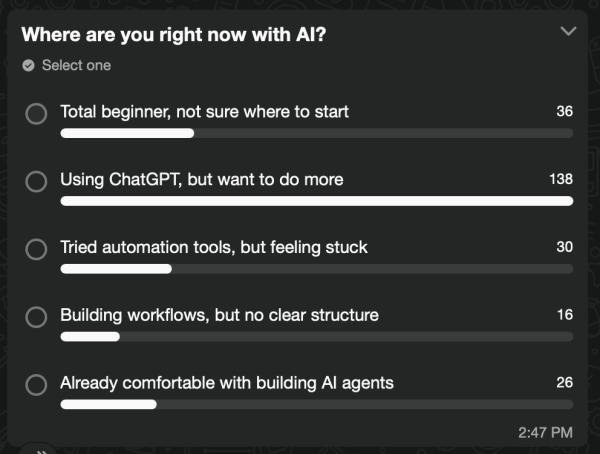
We asked our community a simple question: “Where are you right now with AI?” Over 200 people answered. And the most popular response, by a wide margin, was this:

Using ChatGPT, but want to do more

138 people said that. That is not a coincidence. That is a pattern. And it made us ask: why do so many motivated, capable people feel stuck at exactly this stage?

The answer is not the tool. It is the mental model people bring to the tool.

The Search Engine Trap

When most people first open ChatGPT, they use it the way they have used search engines for two decades. They type a question. They get an answer. They move on.

And ChatGPT is very good at this. It gives confident, well-written answers at impressive speed. So people keep using it. Every day, a little more. They draft emails. Write captions. Summarize documents.

But then they hit a ceiling. The tool feels useful but not transformative. They sense there is more. They just do not know what the more looks like.

The Core Tension

You can use ChatGPT as a faster way to do old things. Or you can use AI agents to build entirely new things. The gap between those two approaches is enormous, and almost nobody talks about what actually crosses it.

What Actually Building Looks Like

The shift happens when you stop thinking of AI as a tool you interact with and start thinking of it as an agent you design around. That is when ChatGPT stops being a smart assistant and becomes the engine inside a much larger machine.

What does that look like in practice? It looks like agents. AI that does not wait to be asked. It monitors, decides, executes, and loops back on its own. Instead of you prompting every time you need something, you build an agent that runs itself. You define the logic. The AI does the work.

1
Prompting is a conversation. You ask, it answers. Powerful, but still manual. You are in the driver seat every single time.
2
Automation is a trigger chain. An email arrives, the AI reads it, drafts a reply, and files the original. You set it up once and it runs.
3
Agents are autonomous loops. The AI monitors inputs, makes decisions, executes tasks, and adapts, without you being in the loop for every step.

Why the Gap Exists

Nobody teaches you this transition. OpenAI’s interface is a chat box. It is literally designed to look like a conversation, not a workflow. So you use it like a conversation. Of course you do.

But the same model powering that chat box can be connected to your inbox, your calendar, your database, your social media, your backend. It can trigger on events, pass information between tools, make conditional decisions, and run while you sleep.

The people who figured this out are not necessarily more technical. They just asked a different question. Not “what can I ask AI to do?” but “what would I hand off to an agent if I could?”

The question is not what you can ask AI to do. It is what you would hand off if you trusted it enough to let go.

Your Next Step

If you are in that 138, using ChatGPT daily and sensing there is more, you are not behind. You are at exactly the right place to make the leap. The foundation is already there.

What comes next is not learning to write better prompts. It is learning to think in agents. To map your repetitive work. To identify the one thing you would automate first if you knew how. And then build it.

That gap is a lot smaller than it looks from the outside. And you do not have to cross it alone.

Ready to build your first agent?

Schedule a call with our team and we will help you map exactly where to start.

Schedule a call
arArabic